
The PUMP Act: What Are Your Rights?
The Providing Urgent Maternal Protections for Nursing Mothers (PUMP) Act guarantees most employees the right to reasonable break time to express breast milk for up to one year following the birth of a child. Furthermore, the legislation mandates that employers provide a private, functional space—strictly excluding bathrooms—that is shielded from view and free from coworker or public intrusion. These federal safeguards ensure that nursing parents can maintain their lactation schedules without compromising their professional responsibilities or personal dignity.
Organizations must navigate workplace lactation rights with a thorough understanding of recent legislative advancements, specifically the PUMP Act and the Pregnant Workers Fairness Act (PWFA). While these federal mandates establish essential baseline protections for nursing mothers, forward-thinking organizations recognize that compliance extends beyond mere legal adherence. Providing dignified, compliant spaces represents a strategic investment in employee retention, morale, and overall well-being. When companies invest in versatile wellness environments, they support the entire workforce. A thoughtfully designed private space accommodates not only compliant pumping but also facilitates telehealth appointments, therapy sessions, meditation and reflection, faith-based practices, and medication management.
PUMP Act Protections: What the Law Requires
Under the Fair Labor Standards Act, the PUMP Act expands critical protections to millions of workers. Employers must understand the specific parameters governing break times and physical environments to ensure full compliance.
Break Frequency and Duration: The law refrains from dictating a rigid schedule or strict time limits. Instead, it requires employers to grant reasonable break time whenever a nursing employee needs to express milk. Because biological needs vary significantly, the frequency and length of these sessions will differ among individuals and may fluctuate over the course of the first year postpartum.
The Private Space Requirement: Organizations must supply a designated area for pumping that is entirely separate from a restroom. Even a private, single-stall bathroom violates federal regulations. The provided location must be completely shielded from external view and secure against interruptions from colleagues or the public. Whether the space is a permanent installation or a temporary setup, it must remain fully functional and immediately available whenever the employee requires it.
Intersection with the PWFA: The Pregnant Workers Fairness Act further fortifies these rights by mandating reasonable accommodations for pregnancy, childbirth, and related medical conditions, which explicitly includes lactation. This means employers may need to provide additional supportive measures, such as access to refrigeration, nearby running water, and appropriate seating, provided these adjustments do not cause undue hardship to the business.
Key Requirements for a Workplace Breastfeeding Policy
What are the key requirements for a workplace breastfeeding policy under current laws? Establishing a formalized, written protocol ensures legal compliance while fostering a culture of transparency and support. Organizations should implement a comprehensive framework that outlines expectations for both management and staff.
Statement of Support and Eligibility: Clearly articulate the organization's commitment to accommodating nursing employees, specifying that protections apply to all eligible staff members for at least one year after childbirth.
Accommodation Request Procedures: Define the exact steps an employee must take to request lactation breaks and access to the designated space, including whom to contact and the expected response times from management.
Space Specifications and Usage Guidelines: Detail the location, amenities, and scheduling system for the private pumping area, explicitly confirming that the space is not a bathroom and remains secure from intrusion.
Break Time Parameters: Explain that employees are entitled to reasonable breaks as frequently as needed, acknowledging that duration and frequency will vary based on individual physiological requirements.
Compensation and Timekeeping Rules: Clarify how pumping breaks intersect with paid time. Specify that employees must be compensated if they are not completely relieved of their duties or if they utilize standard paid rest periods to express milk.
Anti-Retaliation Assurances: Include a robust non-discrimination clause guaranteeing that employees will not face adverse actions, harassment, or professional setbacks for exercising their legal rights to pump at work.
Your Rights for Breastfeeding Breaks and Space at Work
What rights do I have for breastfeeding breaks and space at work? From the perspective of the employee, federal law guarantees specific entitlements designed to protect your career and your health. You possess the fundamental right to request and utilize lactation accommodations without fear of retaliation, demotion, or termination.
If you choose to work while expressing milk—such as answering emails or taking conference calls—your employer must compensate you for that time at your regular rate of pay. Furthermore, you are not required to submit medical documentation or a physician's note to justify your need for pumping breaks. If an employer fails to provide adequate space or time, you have the authority to seek recourse and demand compliance.
For authoritative guidance and comprehensive details regarding your entitlements, you should consult official government resources. You can review the Department of Labor guidelines by visiting dol.gov/agencies/whd/pump-at-work and explore the Equal Employment Opportunity Commission directives at eeoc.gov/time-and-place-pump-work-your-rights. These platforms offer definitive information on navigating workplace protections and addressing potential violations.
Federal Versus State Lactation Laws: A Comparison
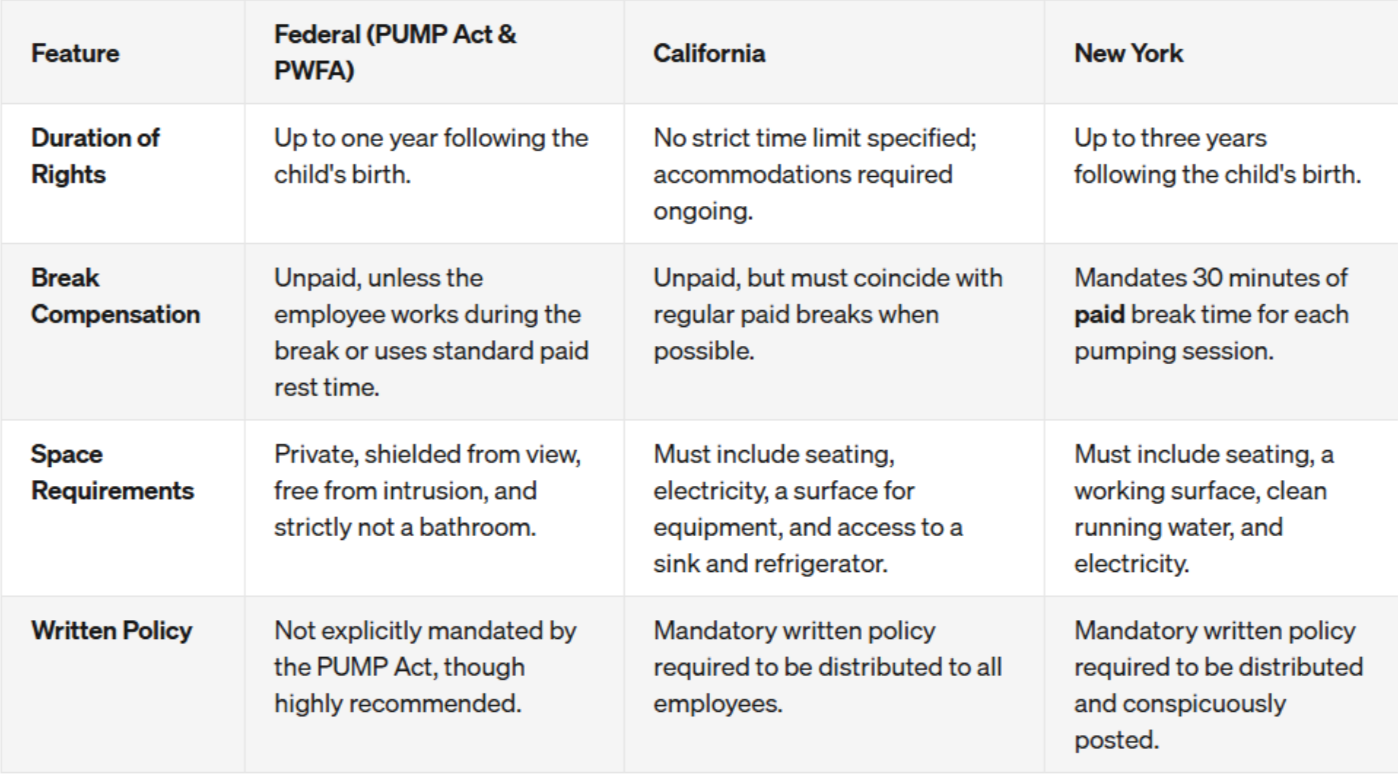
While federal legislation establishes a universal baseline, numerous states have enacted stricter regulations that supersede federal minimums. When state laws offer greater protections, employers must adhere to the more generous standard. Below is a comparison illustrating how the federal PUMP Act contrasts with specific state-level mandates in California and New York.
Elevating Workplace Wellness With Dedicated Lactation Solutions
Achieving compliance with the PUMP Act and state-level mandates does not have to be a logistical burden. Forward-thinking organizations utilize these requirements as an opportunity to enhance their facility infrastructure. By investing in purpose-built lactation room and pod solutions, companies eliminate the guesswork associated with creating private, secure, and comfortable environments.
Premium freestanding pods offer immediate compliance, featuring integrated seating, power outlets, and secure locking mechanisms that guarantee privacy. These structures not only fulfill legal obligations for nursing mothers but also serve as versatile wellness spaces for the broader team. To explore how innovative design can streamline your compliance strategy and elevate your organizational culture, discover the comprehensive range of solutions available on the Work& product pages. Providing a dignified space demonstrates a profound commitment to your workforce, ensuring that every employee feels valued, supported, and empowered to succeed.