
Planning Your Lactation Room
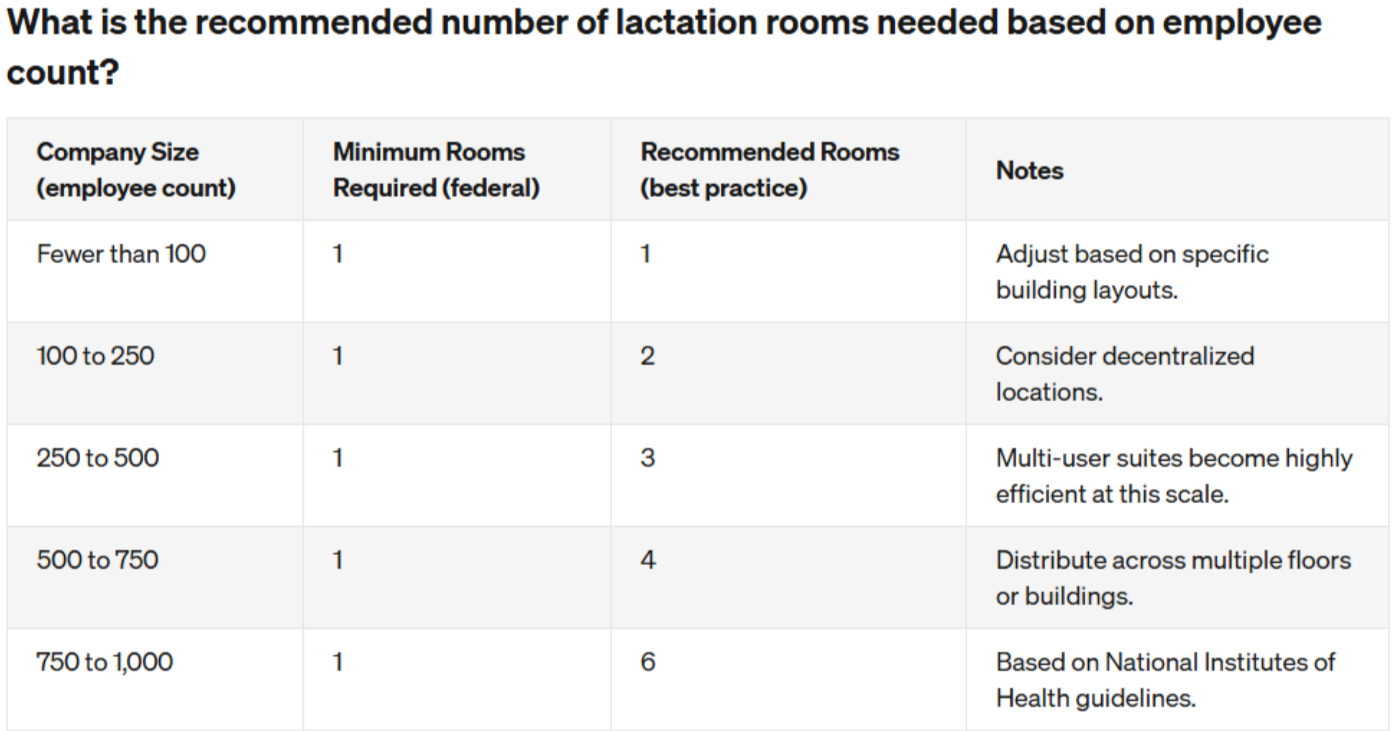
When leaders ask, "How many lactation rooms should my workplace have for easy access?" they must evaluate their total employee population against federal guidelines and architectural standards. A baseline metric requires providing at least one dedicated space for every 50 to 100 female employees, scaling upward as the workforce expands. Accurate capacity planning serves as a necessary investment in working parents, employee retention, and regulatory adherence.
The 7 Rules of Lactation Room Capacity Planning
The PUMP Act requires a dedicated space that is completely protected from observation and is not a bathroom or toilet stall. According to dol.gov Fact Sheet #73A, employers must provide a private environment free from intrusion by coworkers and the public. Restrooms are legally prohibited for milk expression due to severe sanitary concerns.
The American Institute of Architects recommends a minimum room size of 49 to 60 square feet to ensure wheelchair accessibility. Guidelines from aia.org indicate that a seven-foot by seven-foot footprint allows for a proper turning radius, ensuring the space accommodates all employees comfortably and equitably.
Organizations should provide one lactation room per 50 to 100 female employees to ensure adequate availability. Data from womenshealth.gov establishes this ratio as a standard benchmark to prevent scheduling conflicts and support working parents effectively throughout the business day.
Spaces must be located within a five- to seven-minute walking distance from the primary work area of the employee. Proximity is critical for functional access; womenshealth.gov notes that minimizing travel time reduces the overall duration of pumping breaks and supports operational efficiency.
Rooms require sound-dampening materials to ensure auditory privacy for working parents. Architectural standards from aia.org advise implementing acoustic treatments, such as a minimum Sound Transmission Class (STC) rating of 45, to prevent sound from traveling into adjacent corridors or workspaces.
Employers must provide a secure area for nursing employees to store pumping equipment and insulated coolers. As outlined in dol.gov Fact Sheet #73A, while a refrigerator is not strictly mandated, employees must have a safe, designated place to keep their personal cooling devices and breast pumps during their shifts.
Lactation spaces must feature functional amenities, including a chair and a flat surface for equipment. Federal guidance from dol.gov Fact Sheet #73A specifies that the surface cannot be the floor, and the environment should ideally offer access to electricity to facilitate the use of electric pumps.
Considerations for Multi-Floor Buildings and Hybrid Workforces
Complex workplace environments require strategic adaptations to standard capacity formulas. When employees operate across expansive, multi-floor buildings, centralizing all lactation spaces in a single area creates logistical barriers. Leaders should deploy decentralized POD placements to maintain the required five- to seven-minute walking distance across the entire facility.
For organizations managing hybrid schedules, static capacity planning often falls short. Implementing R.A.M.™ (Room Access Management) technology allows managers to facilitate anonymous, data-driven booking and track utilization rates without collecting personal information. This approach ensures that spaces are available precisely when needed. Furthermore, these private environments serve the whole workforce by accommodating compliant pumping, telehealth and therapy sessions, meditation and reflection, faith-based practice, and medication management.
Legal Disclaimer
The information provided in this article is for educational and planning purposes only and does not constitute legal advice. Employers must consult their own legal counsel regarding specific obligations under the Providing Urgent Maternal Protections for Nursing Mothers Act (PUMP Act) and the Pregnant Workers Fairness Act (PWFA) to ensure full regulatory adherence.
Plan Your Lactation Space Strategy
Accurate capacity planning requires a structured approach and deep expertise. Work& supports PUMP Act compliance by helping organizations design and implement effective lactation Room and POD configurations tailored to their specific workforce demographics.
Consult directly with Work& founders Abbey Donnell (Co-Founder & CEO) or Jules Lairson (Co-Founder & COO) to develop a comprehensive strategy for your facilities. No Sales Reps. Just Abbey or Jules. Contact Work& today to begin your capacity planning assessment.