
What You Need to Know About Flexible Office Space
Flexible office space is an agile workspace model that provides companies and employees with on-demand, adaptable environments rather than rigid, assigned seating. It allows organizations to scale their real estate footprint based on actual utilization while offering workers a variety of settings tailored to specific tasks. This approach transforms traditional, long-term leases into dynamic, shared resources that support modern hybrid work schedules.
For decades, organizations relied on static floor plans that tethered individuals to specific desks. Now, business leaders recognize that rigid real estate models no longer serve the needs of a dynamic workforce. The transition toward adaptable environments prioritizes people-first design, optimizing operational costs while fostering well-being, focus, and collaboration.
What does flexible office space mean for employee work styles?
Providing employees with autonomy over where and how they work significantly reduces professional stress. Different personality types require different settings to perform effectively; introverted individuals may require absolute silence to concentrate, while extroverted team members often thrive in active, communal areas. Flexible office space accommodates these diverse needs through activity-based working.
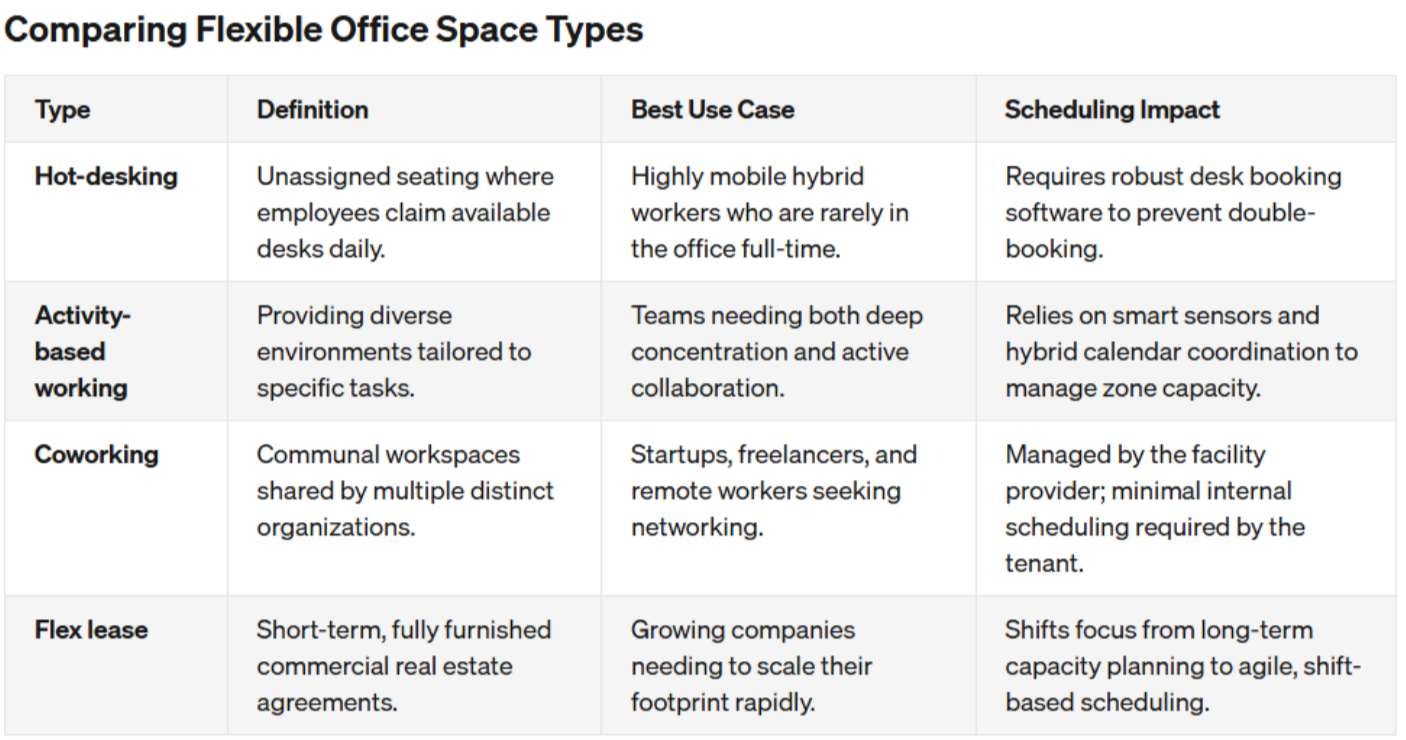
This methodology replaces the standard cubicle farm with a variety of purpose-built zones. Hot-desking allows transient workers to claim available desks for the day, ensuring space is never wasted. Quiet zones offer sanctuary for deep concentration and complex problem-solving. Conversely, open collaboration spaces facilitate group discussions and project planning. By matching the physical environment to the specific task at hand, organizations support the mental well-being and productivity of their entire workforce.
What is flexible office space and how can it help with scheduling?
The success of a shared environment relies heavily on intelligent scheduling logistics. As companies move away from permanent seating, they must implement shift-based scheduling to manage the flow of employees entering the building. This logistical coordination prevents overcrowding and ensures that every individual has a dedicated place to work upon arrival.
To manage these shared resources efficiently, organizations utilize desk booking systems. These digital platforms allow employees to reserve specific workstations or private areas in advance. Furthermore, smart sensors monitor real-time occupancy, releasing unutilized spaces back into the booking pool to maximize availability. When integrated with hybrid calendar coordination, these technologies prevent logistical conflicts, ensuring that teams can align their in-office days for collaborative projects without double-booking essential resources.
How is flexible office space defined in commercial real estate?
In the commercial real estate sector, flexible office space represents a fundamental departure from conventional property agreements. Historically, companies committed to traditional five-to-ten-year leases, which required heavy capital expenditures for construction, furnishing, and infrastructure. Today, the market favors short-term tenancy and flex leases. A flex lease provides a fully furnished, move-in ready environment with agreements that can span months rather than decades. This model shifts real estate from a rigid capital expenditure to a predictable operational cost, allowing organizations to scale their physical footprint in direct response to actual utilization.
Data strongly supports this transition. According to a 2022 survey by JLL, 77 percent of business leaders consider hybrid work essential for attracting talent, and 43 percent plan to invest in flexible real estate by 2025. Furthermore, research conducted by CBRE in 2024 indicates that 80 percent of current office occupiers have adopted and will sustain hybrid work policies. These figures demonstrate that adaptable real estate is a permanent requirement for modern business operations.
Integrating Wellness into the Flexible Office
A complete flexible office strategy must account for the physical and mental health of the workforce. Integrating wellness into the shared environment requires providing private, bookable spaces that support personal needs throughout the workday. Work& workplace wellness solutions serve as essential flexible assets in this regard. Specifically, lactation PODS and private wellness Rooms offer secure, adaptable environments that cater to the whole workforce.
To ensure these spaces function effectively within a shared office, they utilize R.A.M.™ (Room Access Management) technology. This system supports anonymous, straightforward booking, allowing employees to reserve private time without disclosing their personal needs to management or colleagues. These private environments accommodate a wide range of essential use cases, including compliant pumping for working parents, telehealth and therapy appointments, meditation and reflection, faith-based practice, and medication management. By incorporating these dedicated wellness spaces, organizations demonstrate a tangible commitment to employee well-being while maximizing the utility of their flexible real estate.
This information does not constitute legal advice and employers should consult their own counsel regarding the Providing Urgent Maternal Protections for Nursing Mothers Act (PUMP Act) and the Pregnant Workers Fairness Act (PWFA).